When the Government Controls the Prison and the Healthcare, Denying Treatment Is More Than a Policy Debate

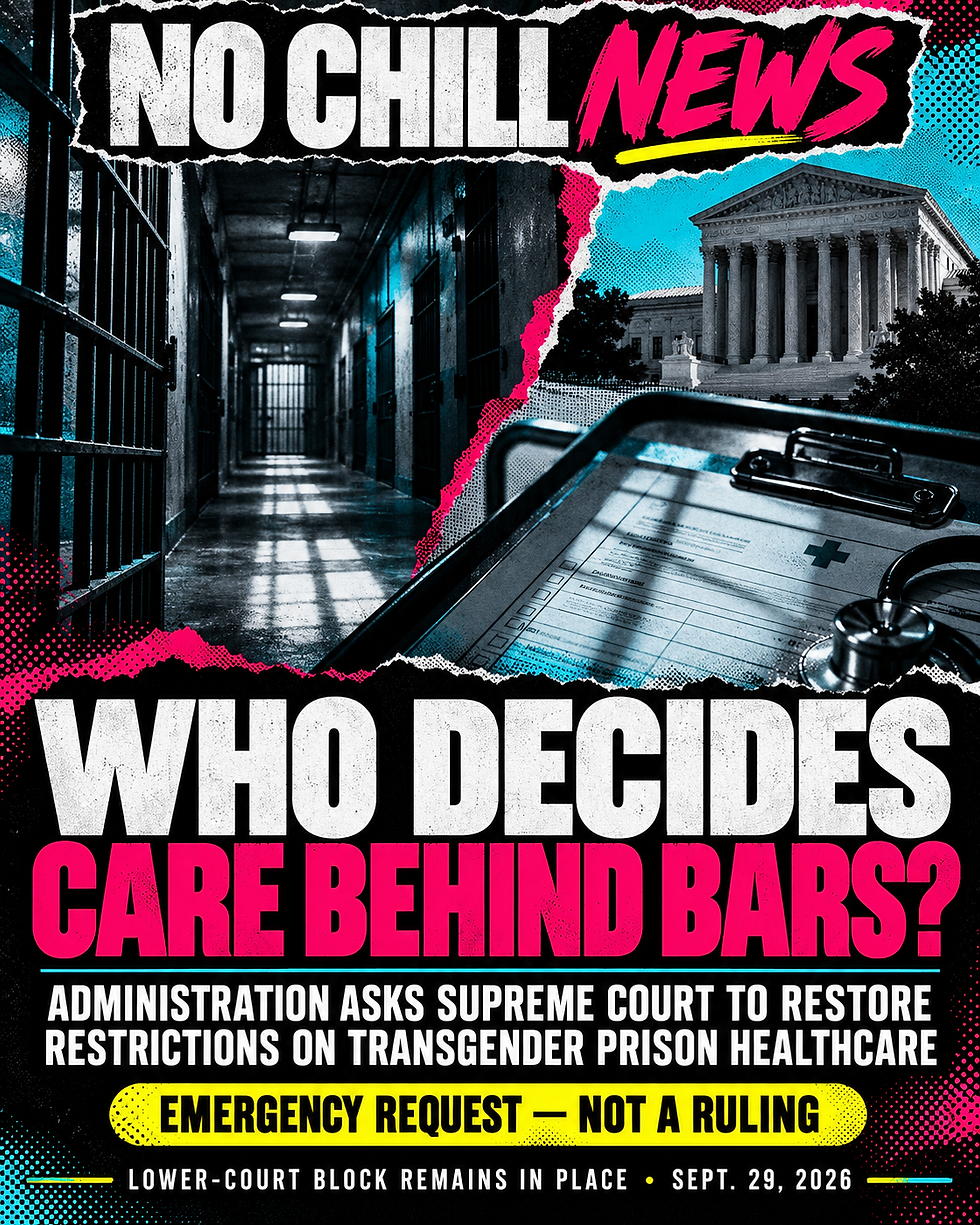
The Trump administration has asked the Supreme Court to let it enforce restrictions on gender-affirming healthcare for transgender people in federal prisons while a lawsuit continues. The Justice Department filed the emergency request Monday, September 28. The Court has not ruled on it.
The request puts a direct question before the justices: Can the Bureau of Prisons put its new policy into effect now, despite a lower-court order blocking it? For people in federal custody, the answer could determine whether treatment they receive is interrupted. They cannot simply choose another provider outside the prison system.
What the policy would change
A Bureau of Prisons policy issued in February restricts hormone treatment, surgery and certain accommodations related to appearance for people diagnosed with gender dysphoria. It continues to allow psychiatric services. Three incarcerated transgender women challenged the administration’s approach on behalf of a broader class of people in federal custody with that diagnosis. The Bureau reported in 2025 that more than 600 incarcerated people were receiving hormone therapy.
The administration says its policy reflects medical and prison-security judgments. The plaintiffs argue that it replaces individualized treatment decisions with broad restrictions and puts patients at risk. Those positions are being contested in court; the government’s filing does not establish that the restricted care is medically unnecessary, and the plaintiffs’ allegations are not a final judgment on every legal claim.
What the courts have decided so far
In June, U.S. District Judge Royce Lamberth blocked enforcement of the February policy while the case proceeds. His ruling found that the plaintiffs were likely to succeed on their claim that the Bureau’s decision was arbitrary and capricious under federal administrative law. The D.C. Circuit declined to lift the block on September 18. The Justice Department is now asking the Supreme Court to intervene.
An emergency order would address what happens during the lawsuit. It would not, by itself, end the case or resolve every question about constitutional rights and medical care in prison. For patients whose treatment depends on the Bureau, though, a temporary ruling can have immediate consequences.
The questions people in custody need answered
If the Supreme Court allows the restrictions to take effect, what happens to someone already receiving hormones? Would treatment stop abruptly, taper under medical supervision or continue after an individualized review? What care remains available to someone whose clinician believes a restriction would put them at risk?
The Bureau should also explain how its policy addresses self-harm and suicide risks, how patients can appeal a treatment decision, and whether outside clinical recommendations will be considered. Prison-health physicians, formerly incarcerated transgender people, advocates and the Bureau itself should be heard on how those procedures work in practice.
The government controls both the prison and access to its healthcare. That makes its duty to explain treatment decisions especially consequential. The Supreme Court has been asked to let the restrictions take effect. Until it rules, the lower-court block remains in place—and the people whose care is at stake are still waiting for an answer.
Reporting basis: Reuters’ September 28 report, Associated Press coverage and Judge Lamberth’s June opinion. No Chill News has not independently interviewed patients, prison clinicians, the Bureau of Prisons or counsel in the case.


Comments