UPDATE: THE CONTRACT IS SIGNED. NOW HOW FAST IS THE AMBULANCE COMING?

Fort Worth firefighters and EMS workers are getting raises and staffing protections after months of contract fighting. Now residents need to know whether those investments translate into faster, more reliable emergency response.
Aqua RichJo— October 1, 2026
After nearly a year of bargaining, accusations of bad-faith negotiations and a summer impasse, Fort Worth firefighters and EMS workers finally have a new contract.
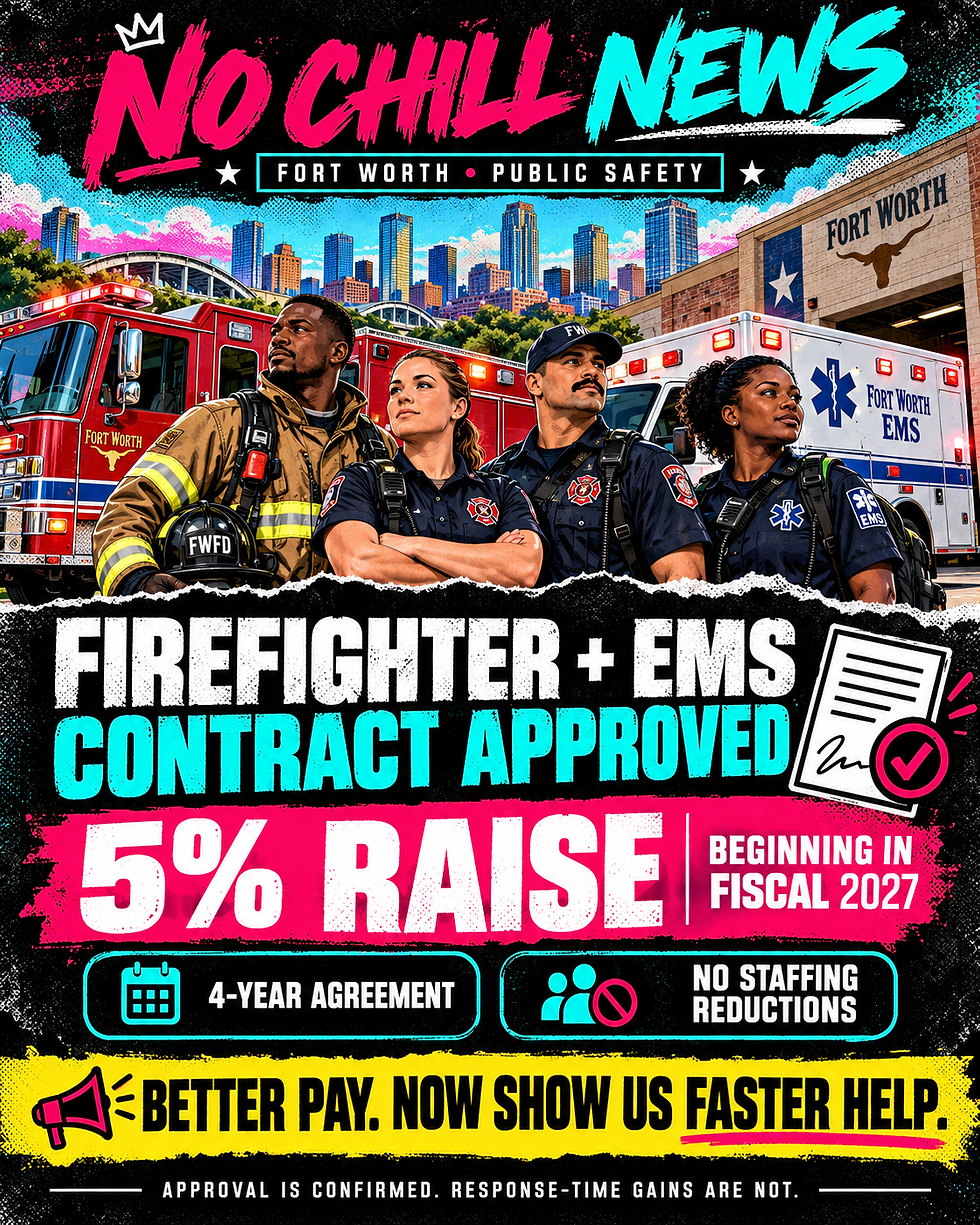
On Tuesday, September 29, the Fort Worth City Council unanimously approved a new four-year collective-bargaining agreement with the Fort Worth Professional Firefighters Association.
Among the biggest changes?
A 5% ACROSS-THE-BOARD RAISE BEGINNING IN 2027.
Additional raises are scheduled during the remaining years of the agreement, including market adjustments based on employee classifications.
The contract also protects against staffing reductions.
After the fight it took to get here, that's significant.
But No Chill News has another question:
WHAT DOES THIS MEAN WHEN SOMEBODY CALLS 911?
Because firefighters and paramedics getting paid appropriately matters.
Keeping enough people on the job matters.
But for the public, this contract ultimately intersects with something much more immediate:
How long does it take for help to arrive?
THIS ISN'T JUST A FIREFIGHTER CONTRACT ANYMORE.
Fort Worth's emergency-response system underwent a massive transformation in 2025.
The city brought EMS operations into the Fort Worth Fire Department after moving away from the former MedStar model. The city says the transition brought EMTs, paramedics and telecommunicators into the department, with former MedStar workers receiving civil-service status through an agreement with Local 440.
FOX 4 reports that the fire department took in approximately 400 employees as part of the MedStar transition.
So when we're talking about this new labor agreement, we're not just talking about people riding fire engines.
We're talking about the workforce Fort Worth depends on when somebody calls 911 and says:
“I can't breathe.”
“My mother isn't waking up.”
“There's been a wreck.”
“Somebody's having a heart attack.”
“We need an ambulance.”
That changes the stakes considerably.
FORT WORTH'S EMS SYSTEM IS HUGE.
According to the city, Fort Worth Fire Department now provides advanced-life-support ambulance service across approximately 436 square miles, serving more than 1 million residents in Fort Worth and 13 surrounding cities.
The system responds to roughly 190,000 calls annually and operates a fleet of 65 ambulances.
Read that again.
190,000 CALLS A YEAR.
That's more than a labor-contract story.
That's infrastructure.
And in a system carrying that kind of workload, staffing isn't an abstract number buried in a contract.
Staffing can affect overtime.
Overtime can affect fatigue.
Fatigue can affect retention.
Vacancies can affect how resources are distributed.
And resource availability can affect what residents experience when they need emergency help.
LET'S TALK ABOUT THE MONEY.
Under the newly approved agreement, firefighters and first responders are scheduled to receive a 5% across-the-board raise beginning in 2027, followed by additional raises during the remaining three years and market adjustments tied to classifications.
That's important for workers.
But this is where No Chill News wants the numbers.
What is the total projected cost of this contract over four years?
How much of that cost represents salary increases?
How much is connected to benefits?
How much is attributable to the expanded EMS workforce?
How much overtime is Fort Worth currently paying?
And if better compensation improves retention, how much overtime could potentially be reduced?
Because saying workers are receiving a raise tells us what changed for the paycheck.
Residents also deserve to understand what changed for the budget.
THE PEOPLE DOING THIS WORK HAVE BEEN WAITING, TOO.
Fort Worth Professional Firefighters Association President Zac Shaffer described the negotiations as a long process that lasted almost an entire year.
He said the resulting agreement was good for members while keeping public safety intact.
The negotiations weren't always pretty.
FOX 4 reports that in July, the firefighters association accused Fort Worth of failing to bargain in good faith. The city and union ultimately returned to negotiations and reached the agreement approved this week.
Now that everybody has signed on the dotted line, the public conversation shouldn't stop.
Actually—
THIS IS WHERE THE NEXT CONVERSATION STARTS.
SHOW US THE RESPONSE TIMES.
If better compensation and protected staffing are being presented as investments in public safety, Fort Worth should make it easy for residents to see whether emergency service improves.
No Chill News wants the baseline.
What was the average ambulance response time before the MedStar transition?
What is it now?
What percentage of high-priority calls meet the city's response-time standards?
Which neighborhoods experience the longest waits?
Are certain council districts consistently waiting longer?
How frequently are ambulances unavailable because they're already handling other calls?
How much mandatory or voluntary overtime are paramedics working?
What are turnover and vacancy rates?
How many former MedStar workers remain with the city?
And what happens to those numbers over the next four years?
Because you can't tell residents something improved if nobody establishes what “better” actually means.
FOUR MORE PEOPLE SOUNDS GOOD. WHAT DOES IT ACTUALLY CHANGE?
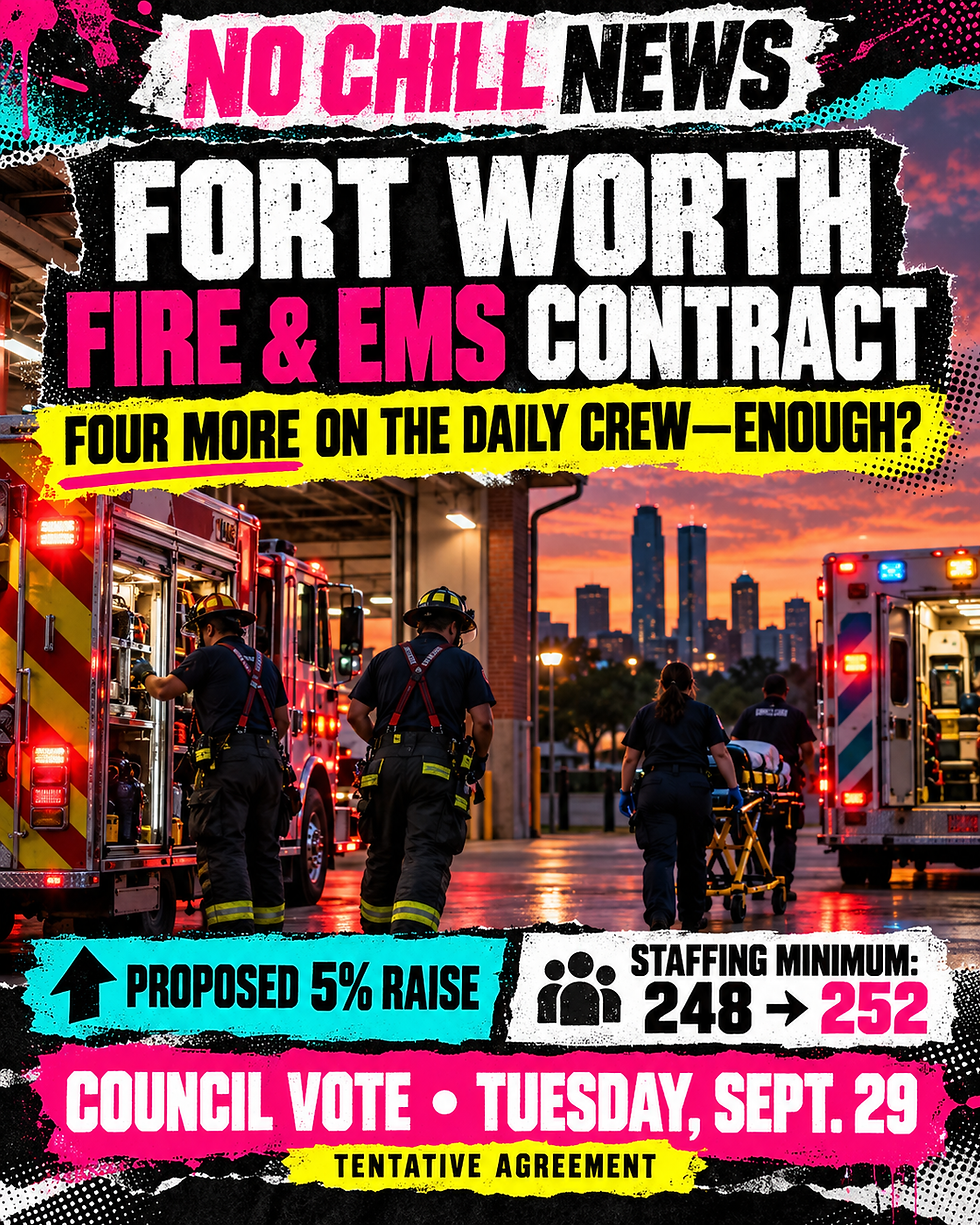
Earlier reporting on the tentative agreement indicated that minimum daily staffing would increase from 248 to 252 as Fort Worth incorporated its expanded EMS workforce.
Four additional daily positions may matter operationally.
But here's what residents need explained:
Where are those four people going?
Are they firefighters?
Paramedics?
EMTs?
Are they assigned to ambulances?
Fire companies?
Communications?
Will those additional positions increase the number of units available at peak times?
Will they reduce overtime?
Will they improve coverage in neighborhoods experiencing longer response times?
Or is the increase primarily necessary to maintain the expanded system Fort Worth already operates?
Those aren't “gotcha” questions.
They're how taxpayers determine whether a staffing number on paper translates into something they can actually experience.
AND LET'S TALK ABOUT THE FORMER MEDSTAR WORKERS.
The people who moved from MedStar into the city's new EMS structure deserve particular attention.
The city says its previous agreement with Local 440 established civil-service status for incoming EMTs, paramedics and telecommunicators during the transition.
So how has that transition actually gone?
Ask them.
Did their pay improve?
Did their benefits change?
Did scheduling improve?
Are they working more overtime?
Less overtime?
Do they feel adequately staffed?
Has the transition improved their ability to provide patient care?
And perhaps most importantly:
ARE THEY STAYING?
A shiny new organizational structure doesn't mean much if experienced paramedics start walking out the door.
AND RESPONSE TIME IS AN EQUITY ISSUE.
A citywide average can hide a lot.
If one part of Fort Worth regularly gets an ambulance quickly while another part waits significantly longer, averaging those numbers together doesn't tell residents the whole story.
That's why Fort Worth should publish EMS performance in a way residents can actually understand:
By geographic area.
By call priority.
By time of day.
By unit availability.
And over time.
Fort Worth's own description of the EMS transition says the goal is a system that is financially sustainable, responsive, timely and focused on high-quality patient care.
Great.
Those are measurable words.
SO MEASURE THEM.
And publish the results.
BETTER PAY MATTERS.
Let's not lose that part.
Firefighters, EMTs, paramedics and dispatchers perform physically and emotionally demanding work.
Recruiting people matters.
Keeping experienced people matters.
Preventing burnout matters.
Paying workers competitively matters.
And protecting staffing levels matters.
The city's previous collective-bargaining framework itself identified recruiting and retaining firefighters, remaining competitive in the regional employment market, providing proper training and equipment and creating a safe and supportive workplace among its guiding principles.
So a contract that improves compensation can absolutely be part of strengthening public safety.
But approving the contract does not automatically prove that emergency response will improve.
That's something Fort Worth now has to demonstrate.
THE NO CHILL BOTTOM LINE
After nearly a year of bargaining, Fort Worth and its firefighters association have an agreement.
Workers are getting raises.
Staffing protections are in place.
The city's new fire-based EMS system is operating at a massive scale.
NOW SHOW US WHAT CHANGES.
Show us ambulance response times.
Show us vacancies.
Show us turnover.
Show us overtime.
Show us staffing by shift.
Show us whether former MedStar workers are staying.
Show us which neighborhoods wait longest.
And then come back in six months.
Come back in a year.
Come back every year of this four-year contract.
Because the real measure of this agreement isn't going to be the press release.
It isn't going to be the unanimous vote.
And it isn't going to be the handshake afterward.
The real test happens at 2:17 in the morning when somebody in Fort Worth calls 911 because somebody they love cannot breathe.
Then there's only one question that matters:
HOW FAST IS HELP COMING?
No Chill News Where the tea is piping and the truth has no filter.
Comments