TEXAS SCHOOLS HAVE NEW RESTRAINT RULES — AND ‘COMPLIANCE’ IS NOT AN EMERGENCY

Aqua RichJo — October 4, 2026
A CHILD REFUSING TO FOLLOW DIRECTIONS IS NOT AUTOMATICALLY A CRISIS.
A CHILD CRYING IS NOT AUTOMATICALLY A THREAT.
AND A CHILD HAVING A DIFFICULT DAY DOES NOT GIVE A SCHOOL UNLIMITED AUTHORITY TO PHYSICALLY RESTRAIN THEM.
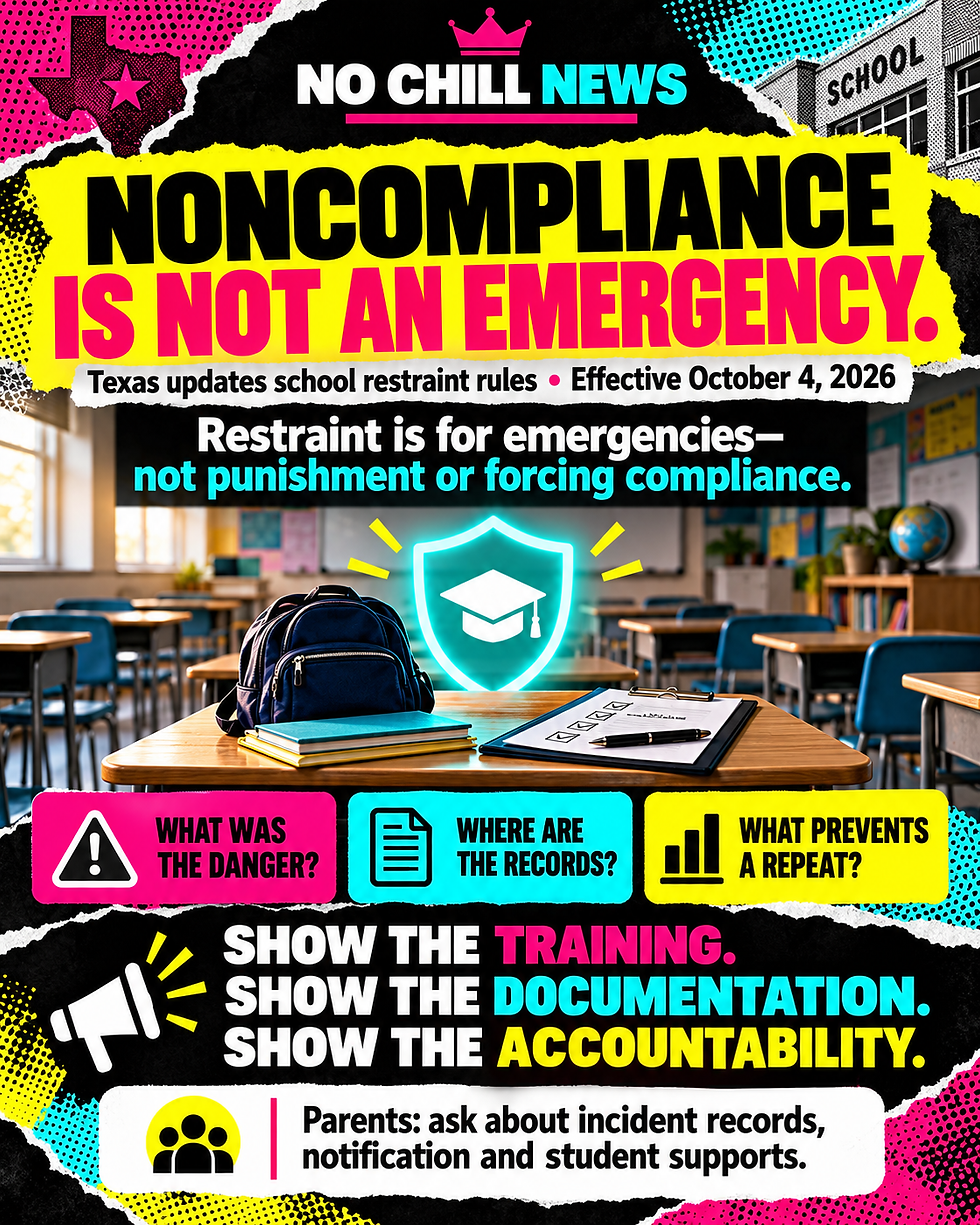
Texas has updated its rules governing physical restraint in public schools, with changes taking effect October 4, 2026.
The central message?
RESTRAINT IS FOR EMERGENCIES — NOT PUNISHMENT, DISCIPLINE OR FORCING COMPLIANCE.
And that distinction deserves serious attention from every parent, educator and school administrator in Texas.
Because when adults physically restrict a child's movement, the question should never be simply whether that child followed directions.
The question is whether there was an actual emergency requiring intervention.
WHAT CHANGED IN TEXAS?
The updated rules clarify the circumstances in which school personnel may use restraint and strengthen expectations surrounding prevention, training, documentation and parent notification.
According to the Texas Register rule summary, the changes address several important areas:
Restraint is restricted to emergency situations rather than punishment, discipline or obtaining compliance.
Crisis-prevention training is required under the applicable rules.
Restraint incidents must be individually documented.
Parents must receive notification within one school day.
For students receiving special-education services, restraint incidents may lead to review through the Admission, Review and Dismissal (ARD) committee or Individualized Education Program (IEP) process.
These requirements are intended to establish clearer boundaries around an intervention that carries serious physical and emotional risks.
A SCHOOL RULE IS NOT A LICENSE TO PUT HANDS ON A CHILD.
WHAT COUNTS AS AN EMERGENCY?
This is where the conversation needs to get specific.
A student might be angry.
A student might be overwhelmed.
A student might refuse to sit down.
A student might yell, cry, leave an assigned activity or struggle to follow instructions.
Those behaviors can require support, supervision, de-escalation or other appropriate responses.
But they do not automatically establish the kind of emergency that justifies physical restraint.
The critical issue is whether the circumstances meet the emergency threshold under the applicable rule.
NONCOMPLIANCE ALONE IS NOT AN EMERGENCY.
And schools should be prepared to explain the difference.
A student's behavior may be challenging without presenting an immediate danger.
A classroom may be disrupted without restraint being justified.
And an adult's frustration is not a substitute for a legally sufficient reason to restrain a child.
DE-ESCALATION SHOULD COME BEFORE A CRISIS
The rules' emphasis on crisis-prevention training matters because prevention is not just about knowing how to respond once a situation becomes dangerous.
It's about recognizing warning signs.
Understanding triggers.
Communicating effectively.
Using appropriate supports.
Reducing unnecessary confrontation.
And knowing when a child needs space, assistance or a different approach.
Training should help staff distinguish between a genuine emergency and behavior that can be addressed without physical force.
That distinction is especially important when working with students who have disabilities, communication differences, sensory needs or behavioral-support plans.
THE GOAL SHOULD BE SAFETY — NOT WINNING A POWER STRUGGLE.
EVERY RESTRAINT INCIDENT NEEDS ITS OWN PAPER TRAIL
Documentation is one of the most important parts of the updated requirements.
Each restraint incident must be documented separately.
Why does that matter?
Because if a child is restrained more than once, those incidents should not disappear into a vague summary of a difficult school day.
Parents and administrators need to understand what happened during each event.
The documentation should allow meaningful review of the circumstances, including the reason for intervention and the response used.
ONE INCIDENT. ONE ACCOUNTABLE RECORD.
When schools keep accurate records, patterns become easier to identify.
When they don't, repeated problems can be much harder to recognize.
PARENTS SHOULD NOT BE LEFT IN THE DARK
The updated rules call for parent notification within one school day.
And that matters.
A parent should not have to learn from their child days later that school staff physically restrained them.
Families need timely information to understand what occurred, check on their child's well-being and ask informed questions.
But notification should not be treated as the end of the conversation.
TELLING A PARENT SOMETHING HAPPENED IS NOT THE SAME AS EXPLAINING WHY IT HAPPENED.
Parents should be able to ask for the relevant incident documentation and understand what follow-up the district plans.
If there are discrepancies between a child's account and the school's explanation, those concerns deserve careful review.
SPECIAL EDUCATION: THE ARD AND IEP CONNECTION
For students receiving special-education services, a restraint incident can raise additional questions.
Was the student's existing support plan followed?
Were appropriate accommodations available?
Did staff recognize known triggers?
Were behavioral interventions implemented as intended?
Does the incident suggest that the student's current supports need to be reconsidered?
Depending on the circumstances and applicable requirements, restraint incidents may trigger review through the student's ARD committee or IEP process.
That review should focus on whether the student has appropriate supports and whether changes are necessary to reduce the likelihood of another emergency.
AN IEP IS NOT JUST PAPERWORK TO FILE AWAY UNTIL THE NEXT MEETING.
It's a plan that should inform how the school supports the student.
And when serious interventions occur, parents deserve to understand how that plan was used.
PARENTS, HERE ARE THE QUESTIONS TO ASK
If your child was restrained at school, don't settle for an explanation that begins and ends with:
“They weren't listening.”
That does not, by itself, explain an emergency.
Ask the school:
1. What happened immediately before the restraint?
What behavior or event led staff to intervene?
2. What specific immediate danger existed?
Who was at risk, and what facts supported that assessment?
3. What did staff try before using restraint?
Were appropriate de-escalation or crisis-prevention measures attempted?
4. Who physically participated?
Which employees were involved, and what training had they received?
5. How long did the restraint last?
When did it begin, and when was the student released?
6. Was my child injured or medically assessed?
Were there any visible injuries, complaints of pain or other health concerns?
7. Where is the incident documentation?
How can the parent obtain and review the records available under applicable rules?
8. Was the child's IEP or behavioral-support plan followed?
If applicable, does the incident require an ARD meeting or other review?
9. Has this happened before?
Are there earlier incidents or patterns that require attention?
10. What is the plan to prevent another incident?
What specific changes will the school make?
PARENTS ARE NOT BEING DIFFICULT BY ASKING FOR DETAILS.
They're asking questions about their child's safety.
And schools should be able to answer them.
THE NO CHILL CHECK: WHAT ARE DISTRICTS ACTUALLY TRACKING?
Here's where written policy meets real accountability.
A district can announce updated rules.
It can distribute a training presentation.
It can tell families that student safety is a priority.
But how does the public know whether those commitments are working?
Districts should examine patterns in restraint incidents, including:
How frequently restraint occurs and whether particular students experience repeated incidents.
Which campuses and staff members are involved.
Whether students receiving special-education services are disproportionately affected.
Whether disparities appear across racial groups.
Whether incidents lead to injuries, complaints or changes in student-support plans.
Whether staff training and prevention strategies are reducing the use of restraint.
These are important oversight questions. They should not be confused with a claim that every proposed public reporting measure is specifically mandated by the October 4 rules.
IF A DISTRICT ISN'T LOOKING FOR PATTERNS, HOW WILL IT KNOW WHEN SOMETHING IS GOING WRONG?
Numbers alone won't tell the entire story.
But consistent records, meaningful review and corrective action can help identify problems before they become repeated harm.
WHAT ABOUT ACCOUNTABILITY WHEN RULES ARE BROKEN?
A policy only matters if schools take compliance seriously.
When a restraint incident is questioned, districts should review whether the intervention met the emergency standard and whether required procedures were followed.
That includes examining documentation, staff training, notification and the circumstances surrounding the incident.
If a violation is established, the district should respond under applicable law and personnel policies.
That response may involve additional training, changes to procedures, supervisory intervention or other appropriate corrective measures.
DON'T JUST WRITE A RULE.
MAKE SURE PEOPLE FOLLOW IT.
And when concerns are raised, don't dismiss them without reviewing the facts.
THE NO CHILL TAKE
Let's make something clear.
Teachers deserve safe classrooms.
Students deserve safe classrooms.
And schools need lawful ways to respond when someone faces an immediate threat of serious harm.
But those responsibilities do not erase the limits on physical restraint.
A child can be loud without being dangerous.
A child can be frustrated without creating an emergency.
A child can refuse an instruction without automatically meeting the threshold for restraint.
And a student with a disability should not have to endure unnecessary physical intervention because appropriate supports weren't provided.
COMPLIANCE IS NOT THE SAME THING AS SAFETY.
The October 4 rule changes put important expectations around when restraint may be used, how staff should prepare and what schools must document and communicate.
Now comes the part that matters most.
Implementation.
Are employees properly trained?
Are parents notified on time?
Are incidents recorded separately?
Are repeated restraints investigated?
Are student-support plans being reviewed when needed?
And are districts willing to correct practices that don't meet the rules?
Because a policy sitting in a binder doesn't protect a child.
The adults implementing it do.
A CHILD SHOULD NOT HAVE TO BE HURT BEFORE SOMEONE TAKES THEIR RIGHTS SERIOUSLY.
And if a school cannot clearly explain the danger that justified restraint, parents have every reason to request the records, ask for a review and seek answers.
THE STANDARD IS EMERGENCY.
NOT INCONVENIENCE.
NOT FRUSTRATION.
NOT “THEY WOULDN'T LISTEN.”
SHOW. THE. DOCUMENTATION.
SHOW. THE. TRAINING.
SHOW. THE. ACCOUNTABILITY.
No Chill NewsWhere the tea is piping and the truth has no filter.
THE NO CHILL QUESTION
Should Texas school districts be required to publicly report restraint incidents by campus, disability status and race, while protecting student privacy, so families can identify patterns and hold schools accountable?
Source: Texas Register — rules effective October 4, 2026.


Comments