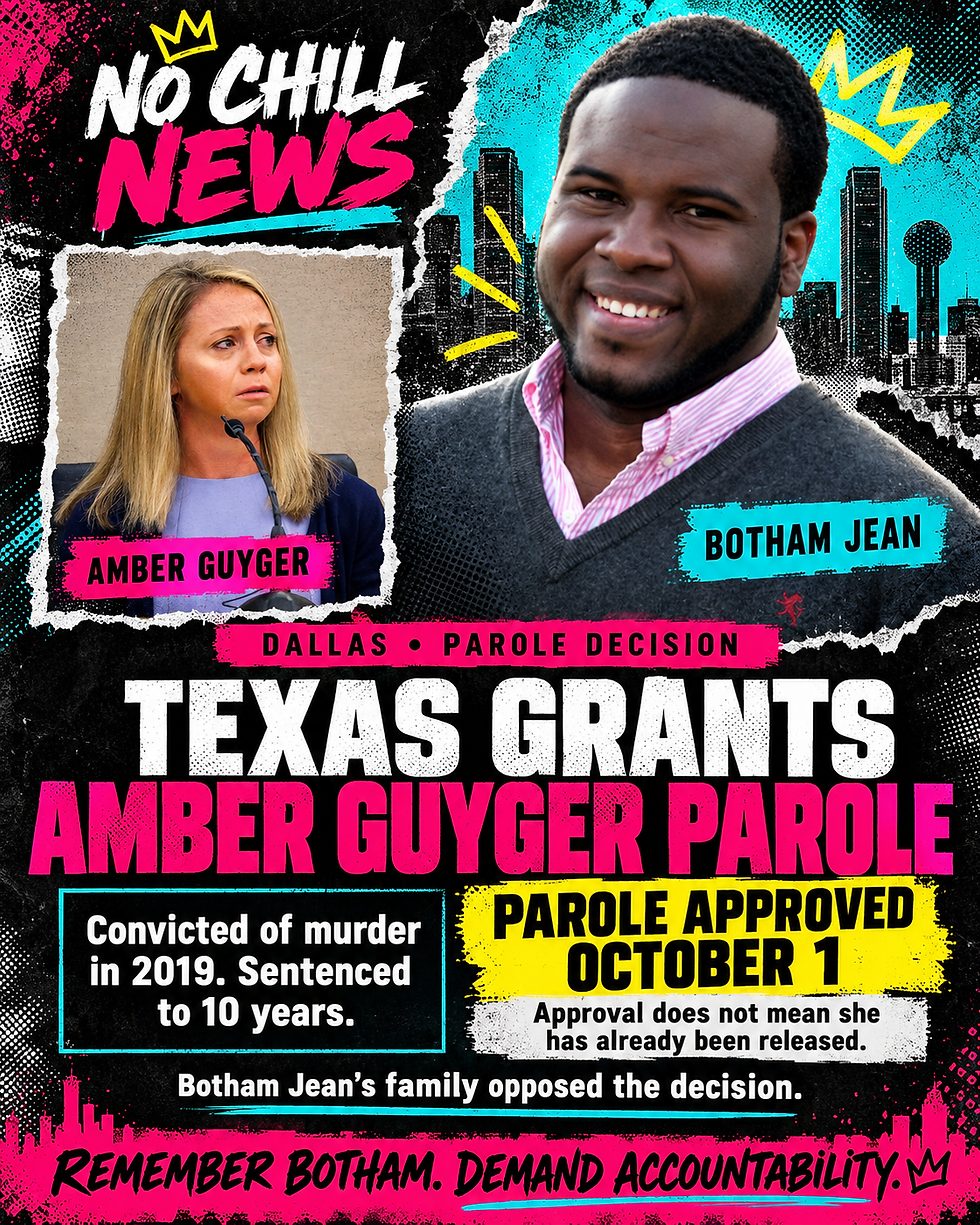
TEXAS GRANTS AMBER GUYGER PAROLE OVER BOTHAM JEAN FAMILY’S OBJECTION

Aqua RichJo / October 5,2026
Seven years.
That's how much time has passed since former Dallas police officer Amber Guyger was convicted of murdering Botham Jean.
Now, the Texas Board of Pardons and Paroles has decided she's eligible to come home.
On October 1, the board approved Guyger for parole after previously denying her first application in 2024.
And Botham Jean's family?
THEY STRONGLY OPPOSED IT.
Through civil-rights attorney Lee Merritt, the family said an already-limited punishment for taking Botham's life has now been shortened even further.
And that brings us to a question Texas needs to answer:
WHO GETS MERCY FROM THE SYSTEM — AND WHO GETS EVERY LAST DAY?
REMEMBER WHAT HAPPENED TO BOTHAM JEAN
On September 6, 2018, Guyger entered Jean's Dallas apartment.
She said she believed she had entered her own apartment.
She had not.
Inside was 26-year-old Botham Jean, an accountant, in his own home.
Guyger shot and killed him.
A Dallas County jury ultimately rejected the idea that this was merely some tragic mistake without criminal responsibility.
THEY CONVICTED HER OF MURDER.
Not manslaughter.
Not criminally negligent homicide.
Murder.
In 2019, Guyger received a 10-year prison sentence.
That sentence itself became controversial, particularly among people who questioned whether a civilian—especially a Black defendant—convicted of murder would have received the same punishment.
Now Guyger has been granted parole before serving the full sentence.
NO CHILL CHECK: PAROLE DOES NOT MEAN SHE IS ALREADY OUT
This distinction matters.
The parole board has approved Guyger for release.
That does not mean she walked out of prison the moment the vote happened.
As of the reporting provided for this story, the Texas prison system had not announced an official release date.
The next things the public deserves to know include:
What conditions will govern her parole?
How long will she remain under supervision?
When exactly will she be released?
And what happens if those conditions are violated?
Because “parole granted” and “sentence completed” are not the same thing.
WHY DID THE BOARD APPROVE HER?
According to the board's explanation, factors supporting Guyger's parole included:
Her lack of a documented pattern of violent arrests or convictions.
Her satisfactory adjustment while incarcerated.
And her completion of treatment-plan programming.
Those are legitimate factors for a parole system to consider.
Rehabilitation is supposed to matter.
Behavior in prison is supposed to matter.
People are supposed to be capable of change.
But here's where No Chill News has questions.
DOES THAT STANDARD APPLY EQUALLY?
That's the story underneath the headline.
Not:
“Should parole exist?”
Yes, parole exists for a reason.
The real question is whether the same language about rehabilitation, institutional adjustment and second chances carries the same weight when the person asking for mercy isn't a former police officer.
SHOW US THE COMPARISON
If Texas says Guyger's prison record supports early release, then show the public how those factors are applied across the system.
How many people convicted of murder with similar sentences become eligible for parole after comparable periods?
How many are approved?
How many are denied despite satisfactory prison records?
What do those numbers look like by race?
By gender?
By prior criminal history?
By sentence length?
By occupation?
Because one parole decision cannot answer whether the system is fair.
THE DATA CAN.
The board's brief explanation tells us why it says Guyger qualified.
It does not, by itself, tell us whether similarly situated prisoners receive the same consideration.
That's the accountability question.
BOTHAM JEAN LOST MORE THAN SEVEN YEARS
This is where criminal justice language can become painfully clinical.
“Time served.”
“Parole eligibility.”
“Programming completed.”
“Institutional adjustment.”
Those phrases describe the person incarcerated.
But Botham Jean doesn't get an equivalent review.
There is no parole board restoring the years he lost.
No completed program gives him another birthday.
No satisfactory institutional record sends him back to his family.
BOTHAM JEAN LOST HIS ENTIRE FUTURE.
That doesn't mean rehabilitation shouldn't exist.
It means we shouldn't discuss the rehabilitation of the person convicted of killing him while reducing his life to a paragraph explaining why she went to prison.
AND HIS FAMILY DID NOT AGREE WITH THIS DECISION
Jean's family has lived with this case since 2018.
They endured the criminal trial.
The sentencing.
The appeals.
The parole process.
And now another decision capable of reopening the same trauma.
Their attorney said the family strongly opposed Guyger's release.
That deserves to be reported without demanding that grieving relatives repeatedly perform their pain for the public.
And no—
DO NOT DRAG OUT THAT COURTROOM HUG LIKE IT SETTLED EVERYTHING.
After Guyger's sentencing in 2019, Botham's brother Brandt Jean famously hugged her in court after expressing forgiveness.
That moment traveled around the world.
But one family member's act of forgiveness does not erase the family's broader views.
It does not modify a criminal sentence.
It does not decide parole.
And it does not turn a deeply personal expression of faith or forgiveness into a permanent waiver of public accountability.
FORGIVENESS IS NOT A SENTENCING CREDIT.
Stop treating it like one.
DALLAS POLICE DIDN'T MAKE THIS DECISION
The Dallas Police Department has said it had no role in Guyger's parole decision.
That's another important distinction.
The decision belongs to the Texas parole system.
So accountability questions about why parole was granted should be directed to the people and institutions responsible for making that decision.
That means examining the Texas Board of Pardons and Paroles itself.
Who voted?
What information did members review?
What risk assessments were considered?
What conditions were imposed?
And how does this decision compare with similar cases?
A CIVIL JURY ALSO FOUND GUYGER LIABLE
The criminal conviction isn't the only legal judgment surrounding Jean's death.
In 2024, a federal civil jury awarded Jean's family approximately $98.6 million after finding that Guyger used excessive force and violated Jean's constitutional rights.
That civil verdict and the criminal conviction are separate legal proceedings.
But together they underscore something important:
THIS WAS NOT SIMPLY AN “ACCIDENTAL APARTMENT” STORY.
Guyger was criminally convicted of murder.
A federal civil jury separately found her legally responsible for violating Jean's rights.
Those facts should remain clear as the public conversation shifts toward parole.
THE BIGGER QUESTION IS WHO GETS REHABILITATION
No Chill News believes criminal justice reporting has to leave room for two things to be true:
People can change.
AND SYSTEMS CAN APPLY MERCY UNEQUALLY.
Those aren't contradictory ideas.
If Texas wants prison programming and rehabilitation to mean something, good.
Then make them mean something consistently.
If satisfactory behavior supports parole for Guyger, show whether satisfactory behavior supports parole for other incarcerated people.
Especially Black people.
Especially people without badges, powerful professional networks or nationally recognized names attached to their cases.
We shouldn't have to guess.
RELEASE THE DATA.
THE NO CHILL TAKE
The question isn't whether Amber Guyger should be permanently denied the possibility of rehabilitation because she committed a terrible crime.
The question is whether Texas offers the same belief in rehabilitation to everybody else.
Because Botham Jean was sitting inside his own apartment.
He wasn't committing a crime.
He wasn't threatening an officer.
He wasn't somewhere he wasn't supposed to be.
HE WAS HOME.
Guyger entered the wrong apartment.
Guyger fired the gun.
A jury convicted her of murder.
She received 10 years.
Now Texas has decided she can be released before completing that full sentence.
The parole board says her institutional record and rehabilitation support that decision.
Botham Jean's family says the punishment was already too short.
Both things belong in the story.
But so does the question Texas cannot answer with a three-sentence parole explanation:
WHO ELSE GETS THIS GRACE?
Show us comparable cases.
Show us approval rates.
Show us denials.
Show us how rehabilitation is measured.
Show us whether race matters.
Show us whether professional status matters.
Show us whether being a former police officer matters.
Because if rehabilitation is truly the standard—
IT NEEDS TO BE A STANDARD.
Not a privilege.
Not a special exception.
Not something that becomes persuasive only when the right person stands before the board.
Botham Jean lost his entire future on September 6, 2018.
Texas has now decided that seven years was enough incarceration for the former officer convicted of taking it.
The Jean family has every right to disagree.
And the public has every right to ask:
WOULD TEXAS HAVE SHOWN THE SAME MERCY TO SOMEBODY WHO LOOKED LIKE BOTHAM?
That's not a question one parole decision can answer.
BUT THE RECEIPTS CAN.
No Chill NewsWhere the tea is piping and the truth has no filter.
THE NO CHILL QUESTION:
If rehabilitation and good behavior are enough to justify parole for Amber Guyger, should Texas be required to show how often those same factors result in parole for similarly situated prisoners?
Parole approval does not mean Guyger has already been released. This article is based on the reported parole decision and available information about the criminal and civil cases.


Comments