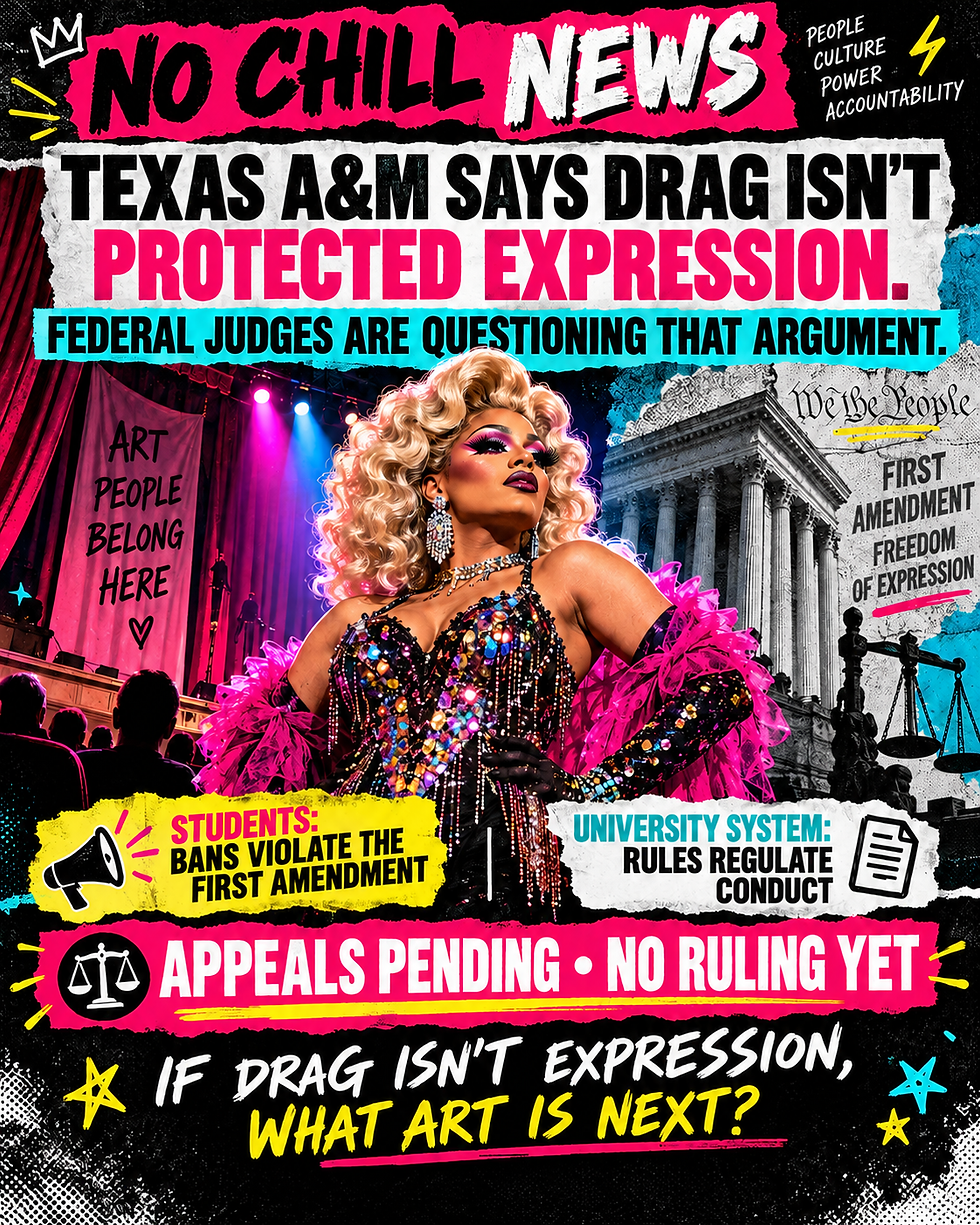
Texas A&M Says Drag Isn’t Protected Expression. Federal Judges Are Questioning That Argument.

Aqua RichJo| September 24, 2026
If a public university can decide a drag show is not protected expression, what happens to the next performance whose meaning officials dislike?
That question was at the center of September 23 arguments before the Fifth U.S. Circuit Court of Appeals. Judges heard two disputes over drag performances at Texas A&M System campuses. Student groups say the restrictions violate the First Amendment. The university defendants say they are regulating conduct and the use of campus venues, rather than suppressing a viewpoint. The appeals court has not ruled.
How did two drag shows reach a federal appeals court?
In 2023, West Texas A&M University canceled a show organized by student group Spectrum WT. Spectrum and two student leaders sued. Then, in 2025, Texas A&M System regents adopted a broader policy barring drag performances at special-event venues across the system. The Queer Empowerment Council, organizer of Texas A&M’s Draggieland pageant, challenged that policy in a separate case.
The lower courts reached different results. A federal judge upheld the West Texas A&M restriction after a trial. Another judge temporarily blocked the systemwide policy, finding that the students were likely to succeed on their First Amendment claim. Those rulings set the stage for the Fifth Circuit arguments; they do not settle both appeals.
The question the judges kept coming back to
Texas A&M’s lawyer argued that administrators targeted the conduct of the performances, not their message. Judges pressed him on how the system could raise concerns about what drag communicates while arguing that the shows do not qualify as protected expression. Asked about the regents’ concern that a performance might promote “gender ideology,” he acknowledged that banning it solely for that reason could present a viewpoint-discrimination problem. He maintained that the court should consider the regents’ other stated reasons as well.
The judges questioned the student groups’ lawyer, too. They asked where the boundary of protected expression should fall and how much control public universities have over performances in campus venues. The students argue that officials cannot reject a show because they object to its viewpoint. The university defendants argue that venue rules may reasonably restrict certain conduct. Those are arguments before the court, not conclusions the appeals judges have reached.
Why artists beyond drag are watching
Drag brings together performance, music, fashion, comedy and LGBTQ+ culture. The court’s eventual reasoning about what counts as expression could matter beyond these two shows. In a brief supporting the Queer Empowerment Council, the ACLU of Texas and Equality Texas warned that requiring art to communicate one clear message could put improvised comedy, dance, theater and music at risk of similar restrictions. That is the advocates’ concern about the possible reach of a ruling—not a finding that those art forms have lost protection.
For the performers and students involved, the question is immediate: Who gets access to a public campus stage, and who decides what their art means? No Chill News wants to hear how campus restrictions affect artists’ work, income, safety and ability to reach an audience. We also want Texas A&M officials to explain how they distinguish a rule about conduct from a judgment about a performance’s message.
The Fifth Circuit has not said when it will rule. Until then, the honest headline is that the First Amendment fight is still being argued—and artists, students and public institutions are waiting for the answer.
Based on Jessica Priest’s September 23 reporting for The Texas Tribune. No Chill News has not independently interviewed the parties or performers discussed here.


Comments