GALVESTON CLASSROOMS HAVE 10 DAYS TO DISPLAY THE TEN COMMANDMENTS — BUT THE CONSTITUTIONAL FIGHT IS NOT OVER

Aqua RichJo — October 4, 2026
Texas says put the posters up. A judge says Galveston ISD has 10 days. But the Constitution? BABY, THAT QUESTION IS STILL IN COURT.
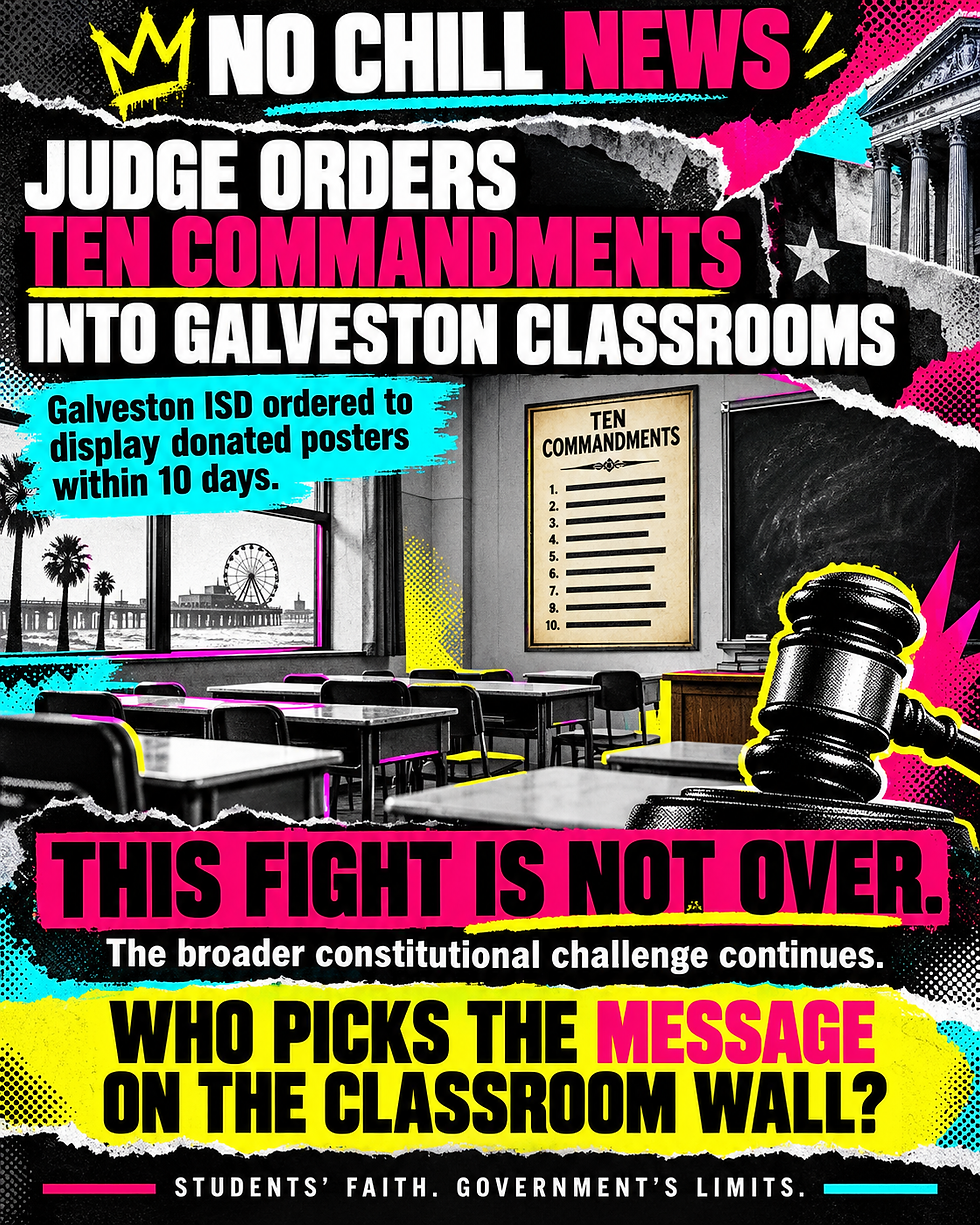
Galveston Independent School District has been ordered to display the Ten Commandments in its classrooms after a legal confrontation with Texas Attorney General Ken Paxton.
On October 1, State District Judge Jeth Jones issued a temporary injunction requiring the district to comply with Texas Senate Bill 10.
The district has agreed to follow the order.
So yes, the posters are going up.
But before anybody starts declaring a permanent victory in the battle over religion in public schools
A COURT ORDER IS NOT THE END OF A CONSTITUTIONAL CASE.
And the legal fight over whether Texas can require religious displays in public-school classrooms is far from finished.
WHAT HAPPENED IN GALVESTON?
Texas Senate Bill 10 requires public schools to display the Ten Commandments in classrooms under the law's specified conditions.
Galveston ISD delayed compliance.
Attorney General Ken Paxton sued.
On October 1, Judge Jeth Jones issued a temporary injunction directing the district to display the posters within 10 days.
Galveston ISD agreed to comply.
That's the immediate situation.
THE DISTRICT HAS AN ORDER. THE DISTRICT SAYS IT WILL FOLLOW IT.
But the order does not answer every legal question surrounding the law itself.
And that distinction matters.
WAIT — DIDN'T OTHER TEXAS SCHOOLS GET BLOCKED FROM DOING THIS?
Yes.
And this is where the legal situation gets complicated.
Eleven other Texas school districts previously received protection under a federal injunction while families challenged the Ten Commandments mandate.
Galveston ISD was not among those protected districts.
That distinction left Galveston exposed to state enforcement even while related constitutional litigation continued elsewhere.
SAME STATE. SAME LAW. DIFFERENT COURT PROTECTIONS.
The Fifth Circuit has allowed the law to operate outside the districts covered by the federal injunction.
Meanwhile, opponents have asked the United States Supreme Court to review the broader constitutional dispute.
So while Galveston faces a state-court compliance order, the larger federal legal challenge remains unresolved.
TEXAS SAYS IT'S HISTORY. CHALLENGERS SAY IT'S GOVERNMENT-SPONSORED RELIGION.
The state argues that the Ten Commandments are part of America's legal and historical tradition.
From that perspective, displaying the text in classrooms acknowledges its historical influence rather than requiring students to practice a religion.
Challengers see it differently.
They argue that requiring a particular religious text in public-school classrooms amounts to government promotion of religion.
And that raises questions under the First Amendment's protections involving religion and government.
HERE'S THE REAL QUESTION:
WHEN DOES TEACHING ABOUT RELIGIOUS HISTORY BECOME THE GOVERNMENT PROMOTING RELIGION?
Because those are not automatically the same thing.
Teaching students about the Ten Commandments in a history or comparative-religion lesson is one issue.
Requiring a religious text to remain displayed in every classroom is another.
The courts are being asked to examine that difference.
PUBLIC SCHOOLS ARE NOT ONE-RELIGION SPACES
This conversation gets flattened into political talking points way too quickly.
One side gets labeled Christian.
The other gets labeled anti-Christian.
And suddenly everybody is yelling while the actual students disappear from the discussion.
WHO EXACTLY IS SITTING IN THESE CLASSROOMS?
Christian students from different denominations.
Jewish students.
Muslim students.
Hindu students.
Buddhist students.
Atheists.
Agnostics.
Students whose families practice other faith traditions.
And children who are still figuring out what they believe.
Every single one of them belongs in a public school.
Every single one of them is entitled to an education.
And their families have legitimate interests in how public institutions handle religious expression.
PUBLIC EDUCATION SERVES THE PUBLIC.
Not just whichever religious tradition has the most political influence at a particular moment.
THIS IS NOT ABOUT BANNING CHRISTIANITY
Let's clear something up.
A constitutional challenge to a government-mandated religious display is not the same thing as a demand to prohibit students from being Christian.
Students can hold religious beliefs.
Families can teach their children religious traditions.
Religious history can be an appropriate subject of academic study.
And public schools must respect students' applicable religious-expression rights.
The dispute here concerns something more specific:
CAN THE STATE REQUIRE A RELIGIOUS TEXT TO BE DISPLAYED IN PUBLIC-SCHOOL CLASSROOMS?
That's a question about government authority.
Not whether individual families are allowed to believe in God.
Not whether Christianity has influenced American history.
Not whether religion is important to millions of Texans.
The question is what the government may require in a public educational setting.
WHAT ABOUT THE TEACHERS?
While attorneys argue in court, educators still have classrooms to manage.
And that creates practical questions.
What instructions are teachers receiving?
Are teachers expected to explain the posters?
What happens if students ask why one religious text is displayed?
Can a teacher discuss other religious traditions in an educational context?
What should educators do when parents raise concerns?
How will districts protect students from religious harassment or exclusion?
And what happens when a classroom discussion turns into a disagreement about faith?
TEACHERS NEED GUIDANCE, NOT JUST A POSTER AND GOOD LUCK.
School districts should be able to explain their implementation procedures clearly to employees and families.
PARENTS DESERVE ANSWERS TOO
Whether a parent supports or opposes Senate Bill 10, they should understand what the district is required to do and what remains legally disputed.
Parents can reasonably ask:
Is the display required in every classroom?
What version of the Ten Commandments is being used?
Who supplies the posters?
Are teachers required to discuss them?
What happens if a student objects?
How will the school protect students of minority faiths and students with no religious affiliation?
Will the district notify families if the court orders change?
These aren't unreasonable questions.
They're questions about how a public school implements a contested state law while serving a religiously diverse student population.
THE FIRST AMENDMENT IS STILL PART OF THE CONVERSATION
The First Amendment protects religious liberty and places limits on government involvement with religion.
Those protections can raise difficult questions when public institutions acknowledge religious history or display religious material.
Supporters of the Texas law argue that historical tradition supports the displays.
Opponents argue that mandatory classroom postings cross a constitutional line.
Those competing legal positions are part of an active dispute.
THE COURTS HAVE NOT FINISHED ANSWERING THE QUESTION.
And Galveston's temporary injunction should not be mistaken for a final nationwide constitutional ruling.
THE SUPREME COURT HAS NOT SETTLED THIS
Challengers have asked the U.S. Supreme Court to review the broader dispute.
But asking the Supreme Court to hear a case is not the same thing as the Court agreeing to hear it.
And even agreeing to hear a case would not mean the justices had already decided its outcome.
A REQUEST FOR REVIEW IS NOT A RULING.
The remaining litigation involving Galveston school board members is also expected to continue.
That means the legal landscape could still change.
Families, educators and districts should pay attention to actual court orders rather than headlines suggesting every question has been resolved.
THE NO CHILL CHECK
Here's what the reporting establishes:
Galveston ISD was ordered to display Ten Commandments posters within 10 days.
The district agreed to comply.
Other districts have been protected by separate federal litigation.
The broader constitutional challenge remains unresolved.
The Supreme Court has been asked to review the issue but has not yet agreed to hear the statewide challenge.
So no, the accurate headline is not:
“THE SUPREME COURT RULES TEXAS CAN REQUIRE THE TEN COMMANDMENTS.”
And it isn't:
“TEXAS TEN COMMANDMENTS LAW DECLARED UNCONSTITUTIONAL EVERYWHERE.”
Neither describes the legal posture presented here.
GALVESTON MUST COMPLY WITH ITS ORDER. THE BROADER FIGHT CONTINUES.
THE NO CHILL TAKE
Texas officials say the Ten Commandments belong in classrooms because of their place in American history and legal tradition.
Opponents say requiring the display puts government authority behind a particular religious text.
Both positions are being tested through the legal process.
But while those arguments unfold, the people most directly affected are students, families and educators.
And the central public-interest question is bigger than one poster.
WHO GETS TO DECIDE WHAT RELIGIOUS MESSAGE THE GOVERNMENT DISPLAYS IN A PUBLIC CLASSROOM?
A public school isn't a private church.
It isn't a synagogue.
It isn't a mosque.
It isn't a temple.
It's a government institution serving families with different beliefs.
That doesn't mean religion must disappear from education.
It means the government has constitutional responsibilities when deciding how religion appears in that setting.
And those responsibilities are precisely what the courts are being asked to examine.
Galveston ISD has a deadline.
The state has an enforcement order.
The challengers have an ongoing constitutional argument.
THREE THINGS CAN BE TRUE AT ONCE.
The district must follow the applicable court order.
Families can continue challenging the law.
And the broader constitutional question remains unsettled.
So before anybody celebrates like the entire legal battle is over—
READ THE ACTUAL ORDER.
FOLLOW THE FEDERAL CASES.
AND STOP CONFUSING COMPLIANCE WITH CONSTITUTIONALITY.
Because a poster can go up in 10 days.
A constitutional dispute can last a whole lot longer.
AND THE FIRST AMENDMENT DOESN'T STOP MATTERING JUST BECAUSE THE DEADLINE IS APPROACHING.
No Chill NewsWhere the tea is piping and the truth has no filter.
THE NO CHILL QUESTION
Should Texas be allowed to require the Ten Commandments in every public-school classroom, or should decisions about religious instruction and belief remain with students and their families?
Sources: Houston Chronicle, Texas Attorney General's Office, Reuters.


Comments