EXXON WANTS BOULDER'S CLIMATE CASE OUT OF STATE COURT. THE SUPREME COURT IS LISTENING.

Aqua RichJo — October 4, 2026
The federal government brought plans for border barriers, surveillance equipment and construction roads to one of Texas's most iconic landscapes.
A federal judge just hit the brakes.
And now the question is bigger than whether somebody supports or opposes a border wall.
WHO GETS TO DECIDE WHAT HAPPENS TO BIG BEND?
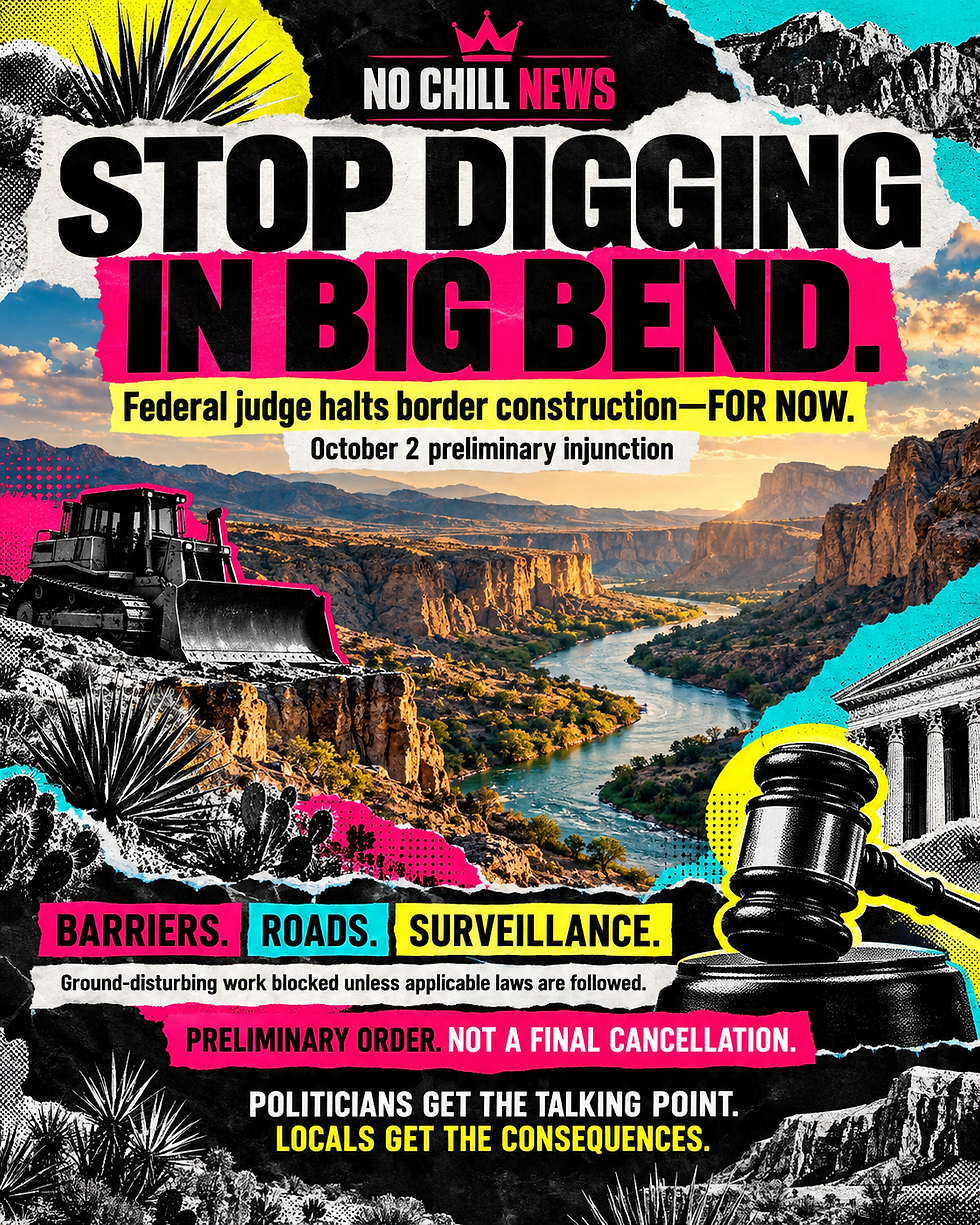
On October 2, U.S. District Judge Kathleen Cardone issued a preliminary injunction blocking the Trump administration from moving forward with certain border-related construction and ground-disturbing activities in the Big Bend region while a lawsuit continues.
We're talking about more than steel barriers.
The judge found that the challengers were likely to succeed on at least one legal claim and faced the possibility of serious, irreversible harm without court intervention.
The order restricts covered construction unless the government complies with applicable environmental laws.
THE BULLDOZERS HAVE BEEN TOLD TO STOP.
But before anybody declares the entire project permanently canceled—
THIS IS A PRELIMINARY INJUNCTION.
The legal battle is still underway.
WHAT DID THE JUDGE ACTUALLY ORDER?
Let's get the facts straight.
Judge Cardone's October 2 ruling temporarily restricts covered border-related construction in the Big Bend region while the underlying legal challenge proceeds.
The order addresses activities that could disturb the land, including construction associated with barriers and supporting infrastructure.
Why?
Because the plaintiffs argued that the federal government was moving forward without satisfying important legal protections.
The judge determined that court intervention was warranted at this stage.
But that does not mean the court has issued a final judgment declaring every aspect of the federal project unlawful.
A TEMPORARY STOP IS NOT A FINAL VERDICT.
The administration can continue defending its actions in court.
The injunction can also be challenged through the legal process.
For now, however, the ruling places meaningful restrictions on the covered work.
And when the subject is permanent damage to land, a temporary restriction can make an enormous difference.
BIG BEND IS NOT AN EMPTY PATCH OF DIRT
Let's talk about the land itself.
Because when national politicians talk about border construction, the conversation can make entire regions sound like blank spaces on a map.
BABY, BIG BEND IS NOT EMPTY.
The region includes environmentally sensitive desert landscapes, river corridors, wildlife habitat, private property, historic sites and communities whose livelihoods are tied to the land.
It is also home to some of the most recognizable scenery in Texas.
<AsyncImageGroup query={["Big Bend National Park Rio Grande Santa Elena Canyon Texas landscape","Big Bend Texas Chihuahuan desert mountains Rio Grande landscape"]} aspectRatio="5:3" layout="carousel"/>
The Rio Grande shapes the geography and history of the region.
Ranchers, landowners, river guides, tourism businesses, conservation organizations and nearby communities all have interests in what happens there.
And unlike a political slogan, the physical consequences of construction don't disappear when the next election cycle begins.
Roads alter landscapes.
Heavy equipment disturbs soil.
Lighting changes nighttime conditions.
Surveillance installations introduce new infrastructure.
Barriers can affect wildlife movement and access.
THAT IS WHY THE DETAILS MATTER.
THIS WAS NEVER JUST ABOUT A GIANT STEEL WALL
When people hear the words border wall, many picture tall steel fencing stretching across the desert.
But the Big Bend plans reportedly involved a broader infrastructure network.
Construction roads.
Vehicle barriers.
Surveillance systems.
Sensors.
Lighting.
Supporting installations.
Those projects can change how people and wildlife move through a region even when the infrastructure isn't a towering physical wall.
And that's why the debate needs to go beyond the image used in campaign advertisements.
A ROAD CAN CHANGE A LANDSCAPE.
A SURVEILLANCE TOWER CAN CHANGE A COMMUNITY'S RELATIONSHIP WITH ITS LAND.
A BARRIER CAN CHANGE ACCESS TO PROPERTY AND THE RIVER.
The physical footprint matters.
So does the legal authority used to create it.
WHO BROUGHT THE LAWSUIT?
The lawsuit was brought by the Center for Biological Diversity on behalf of Friends of the Ruidosa Church and a local river guide and landowner.
The challengers argue that federal officials relied on sweeping legal waivers to advance border construction without adequately respecting environmental, constitutional and property protections.
Their concerns go beyond general disagreement with federal immigration policy.
They are challenging the way the government pursued the project and the legal protections they say were bypassed.
THERE IS A DIFFERENCE BETWEEN HAVING AUTHORITY TO BUILD AND HAVING AUTHORITY TO IGNORE EVERY OTHER RIGHT ALONG THE WAY.
That distinction sits at the heart of this fight.
THE GOVERNMENT'S ARGUMENT: BORDER SECURITY
The federal government maintains that physical border infrastructure can be necessary to maintain control of the border, including if migration patterns change.
That is the administration's stated security rationale.
Border security is a legitimate government responsibility, and federal officials argue that infrastructure can support enforcement operations.
But local opponents question whether the proposed construction is justified in this particular region.
They point to Big Bend's rugged terrain and comparatively low share of Border Patrol apprehensions.
Their argument is that the geography itself already creates significant obstacles to crossing.
SO HERE'S THE QUESTION:
WHAT SECURITY BENEFIT DOES EACH PROJECT PROVIDE, AND HOW DOES THAT BENEFIT COMPARE WITH ITS ENVIRONMENTAL, PROPERTY AND COMMUNITY COSTS?
That is a question government officials should be prepared to answer with evidence.
Not just slogans.
WHEN THE LAND IS DAMAGED, WHO FIXES IT?
This is where the stakes become especially serious.
Construction in a sensitive desert environment can create effects that are difficult to reverse.
Disturbed soil can be vulnerable to erosion.
Wildlife habitat can be fragmented.
Historic landscapes can be altered.
River access can change.
And local businesses may experience consequences from restrictions, construction activity or changes to the surrounding environment.
Not every impact is necessarily permanent.
But some damage can take years or decades to recover from.
And certain losses cannot simply be repaired by removing equipment later.
YOU CANNOT ALWAYS UN-DIG THE DESERT.
That's one reason courts consider the possibility of irreparable harm when deciding whether preliminary relief is appropriate.
The question isn't only whether a lawsuit might eventually succeed.
It's also what could happen before the court reaches a final decision.
HISTORY AND CULTURAL HERITAGE ARE PART OF THIS FIGHT
Big Bend's significance isn't limited to its scenery.
The region includes historic places and longstanding community connections to the land.
The participation of Friends of the Ruidosa Church reflects concerns involving cultural and historic preservation as well as broader environmental issues.
When federal infrastructure projects affect places with deep historical meaning, residents and preservation groups may raise questions that aren't captured by a simple construction map.
What sites could be affected?
What historical reviews were conducted?
What consultation occurred?
What alternatives were considered?
And who decides whether the harm is acceptable?
A PLACE DOESN'T LOSE ITS HISTORY JUST BECAUSE WASHINGTON CALLS IT A PROJECT SITE.
PRIVATE PROPERTY RIGHTS DON'T DISAPPEAR AT THE BORDER
There's another major issue here.
Landownership.
Big Bend includes private property as well as protected and publicly managed lands.
For affected landowners, the debate can involve access, construction, legal authority and the future use of their property.
People may disagree about federal border policy while still agreeing that property rights and lawful procedures matter.
And that brings us to a question worth asking:
HOW MUCH SAY SHOULD A LANDOWNER HAVE BEFORE FEDERAL CONSTRUCTION CHANGES THE PROPERTY AROUND THEM?
The answer depends on the law and the specific property interests involved.
But affected residents deserve clear information about proposed work, legal authority and available remedies.
OPPOSITION HAS CROSSED POLITICAL LINES
This is not a dispute that fits neatly into a red-versus-blue political box.
Local leaders, conservation organizations, landowners and some Texas Republicans have expressed opposition to or concerns about the proposed Big Bend construction.
Their reasons aren't necessarily identical.
Some are focused on environmental protection.
Others are concerned about property rights.
Others question the need for the infrastructure in this particular location.
And some want greater local consultation before decisions are made.
DIFFERENT REASONS. SAME DEMAND: ANSWER THE PEOPLE WHO LIVE THERE.
The disagreement is a reminder that national policy debates can look very different when the consequences arrive at somebody's front gate.
WHERE WAS THE LOCAL CONSULTATION?
Here's a question federal officials should have to answer clearly.
What meaningful opportunities did local residents have to examine and respond to the construction plans before ground-disturbing work began?
Were landowners notified?
Were tourism businesses consulted?
Were river guides heard?
Were historic preservation groups included?
Were environmental impacts publicly explained?
Were alternatives evaluated?
And were local concerns reflected in the final decisions?
Consultation doesn't automatically mean every resident gets veto power over federal policy.
But it should mean affected communities receive meaningful information and opportunities to participate where the law requires them.
DON'T CALL IT COMMUNITY ENGAGEMENT IF THE COMMUNITY ONLY FINDS OUT WHEN THE EQUIPMENT SHOWS UP.
SURVEILLANCE INFRASTRUCTURE DESERVES ITS OWN QUESTIONS
The reported project also includes surveillance-related technology.
That raises questions beyond environmental impact.
Where would cameras and sensors be installed?
What areas would they monitor?
Could they capture activity involving nearby residents or visitors?
How long would information be retained?
Which agencies could access it?
What privacy protections would apply?
Surveillance equipment can serve border-enforcement purposes.
But its use should still be evaluated against applicable legal protections and the interests of people who live and work nearby.
BORDER SECURITY DOESN'T MAKE PRIVACY QUESTIONS DISAPPEAR.
WHAT HAPPENS NEXT?
The lawsuit continues.
The federal government can defend the project and challenge the preliminary injunction through the courts.
The plaintiffs can continue pursuing their legal claims.
And the judge has not yet issued a final ruling on every disputed issue.
Future proceedings may address the scope of federal authority, the challenged legal waivers and the protections that apply to the project.
For now, the injunction restricts covered construction and other ground-disturbing activity under the terms of the court's order.
THE PROJECT IS NOT PERMANENTLY CANCELED.
THE LEGAL CHALLENGE IS NOT OVER.
BUT THE COURT HAS INTERVENED.
Those three facts matter.
THE NO CHILL CHECK
Let's separate the ruling from the political noise.
FACT: A federal judge issued a preliminary injunction on October 2.
FACT: The order restricts covered border construction and ground-disturbing activities in the Big Bend region.
FACT: The challengers raised environmental, constitutional and property-related objections.
FACT: The judge found grounds for preliminary relief, including the likelihood of success on at least one claim and the risk of serious harm.
FACT: The administration maintains that border infrastructure serves security objectives.
FACT: The case is continuing.
What the ruling does not establish is that the entire project has been permanently canceled or that every federal action has already been finally adjudicated unlawful.
PRELIMINARY DOES NOT MEAN PERMANENT.
But it also doesn't mean insignificant.
THE NO CHILL TAKE
Here's what gets lost when national politics turns every border issue into a slogan.
The people debating the project on television don't necessarily have to live beside the construction.
They may never experience changes to river access.
They may never deal with altered property access.
They may never depend on local tourism.
They may never see the effects on wildlife habitat or historic landscapes.
But the people who live and work in Big Bend do.
And those consequences deserve serious consideration regardless of which administration proposes the project.
Border security can be debated.
Infrastructure needs can be evaluated.
Environmental and property protections can be enforced.
THOSE THINGS ARE NOT MUTUALLY EXCLUSIVE.
The government should be able to explain why a project is needed, what it will cost, what land it will affect and what alternatives were considered.
Residents should be able to understand the plans and raise objections through lawful channels.
And courts should be able to examine whether the government followed the law.
That's what this injunction is about.
Not a final declaration that border infrastructure can never be built.
Not proof that every proposed barrier is unlawful.
But a judicial order requiring the government to stop covered work while serious legal questions remain.
NATIONAL POLITICIANS GET THE TALKING POINTS.
BIG BEND GETS THE CONSTRUCTION.
And if that construction leaves permanent consequences, the public deserves answers before the damage is done.
So show us the plans.
Show us the environmental review.
Show us the property protections.
Show us the consultation.
Show us the security justification.
SHOW. THE. RECEIPTS.
Because once a landscape is permanently altered, a courtroom victory years later may not be able to put it back the way it was.
No Chill News Where the tea is piping and the truth has no filter.
THE NO CHILL QUESTION
Should the federal government be required to conduct stronger environmental reviews and meaningful local consultation before approving major border infrastructure projects in environmentally sensitive regions like Big Bend?
Sources: Reuters and The Texas Tribune.


Comments